Is Block Paving Suitable for Driveways With Irregular Shapes?
How Block Paving Can Adapt to Challenging Driveway Layouts
Not every driveway is a simple square or rectangle. Curved boundaries, angled entrances, narrow sections and existing garden features can all create an irregular layout that requires careful planning.
Block paving is often well suited to these spaces because individual units can be arranged and cut to follow complex shapes. For property owners in Farnham, Surrey, a professionally designed block-paved driveway can make practical use of the available ground while creating a neat and balanced appearance.
Why Block Paving Works With Irregular Shapes
Block paving is formed from separate blocks rather than one continuous sheet of material. This modular construction allows the paving to follow curves, changes in width and unusual boundary lines.
The blocks can be laid in different patterns and cut around fixed features. This makes the surface adaptable to driveways containing:
- Curved entrances
- Angled property boundaries
- Narrow access points
- Uneven widths
- Recessed parking areas
- Drainage channels
- Trees or established planting
- Steps, walls and pillars
A detailed layout plan helps ensure these features are incorporated without making the finished driveway look fragmented.
Can Block Paving Follow Curved Boundaries?
Blocks can be cut to follow gentle curves and more complicated edges. The quality of the finish depends on accurate setting out and careful cutting.
Edge blocks should be shaped consistently so that gaps remain controlled and the boundary retains a smooth line. A strong edge restraint is also essential because it holds the paving in position and prevents the outer blocks from spreading under vehicle movement.
Choosing the Right Laying Pattern
The paving pattern affects both the appearance and stability of the driveway. Some patterns are better suited to regular spaces, while others can accommodate changes in direction more naturally.
Common considerations include:
- How vehicles will enter and turn
- The direction of the main sightline
- The number of cuts required around edges
- How different sections of the driveway connect
- Whether a contrasting border will define the shape
- The size and proportions of the selected blocks
For driveways carrying regular vehicle traffic, interlocking patterns can provide particularly effective load distribution. The correct choice should reflect both the driveway’s shape and its intended use.
Using Borders to Define a Complex Layout
A contrasting border can give an irregular driveway a more structured appearance. It may be used to follow the outer boundary, frame a parking area or separate the driveway from paths and planted sections.
Borders can also help manage transitions where the driveway changes direction or width. The aim is to make the design look intentional without introducing so many features that the surface becomes visually cluttered.
Planning Parking and Vehicle Movement
An unusual shape should not prevent the driveway from being practical. Before construction begins, the design should consider how vehicles will move through the space.
Important questions include:
- Is the entrance wide enough for comfortable access?
- Can vehicles turn without crossing vulnerable edges?
- Where will each vehicle normally be parked?
- Will opening doors interfere with walls or planting?
- Are narrow sections likely to restrict movement?
- How will pedestrians pass parked vehicles?
Planning around everyday use helps prevent attractive but impractical design choices.
Managing Drainage Across an Irregular Surface
Water must drain efficiently regardless of the driveway’s shape. Complex layouts may have several corners or changes in direction where surface water could collect if the levels are not planned correctly.
Professional installation should establish suitable falls and direct water towards the intended drainage points. Depending on the layout, this may involve channels, drainage features or permeable paving construction.
Every section must work with the overall drainage plan. Correct levels should be created within the foundation rather than attempted through uneven adjustments to the surface blocks.
Why the Foundation Remains Essential
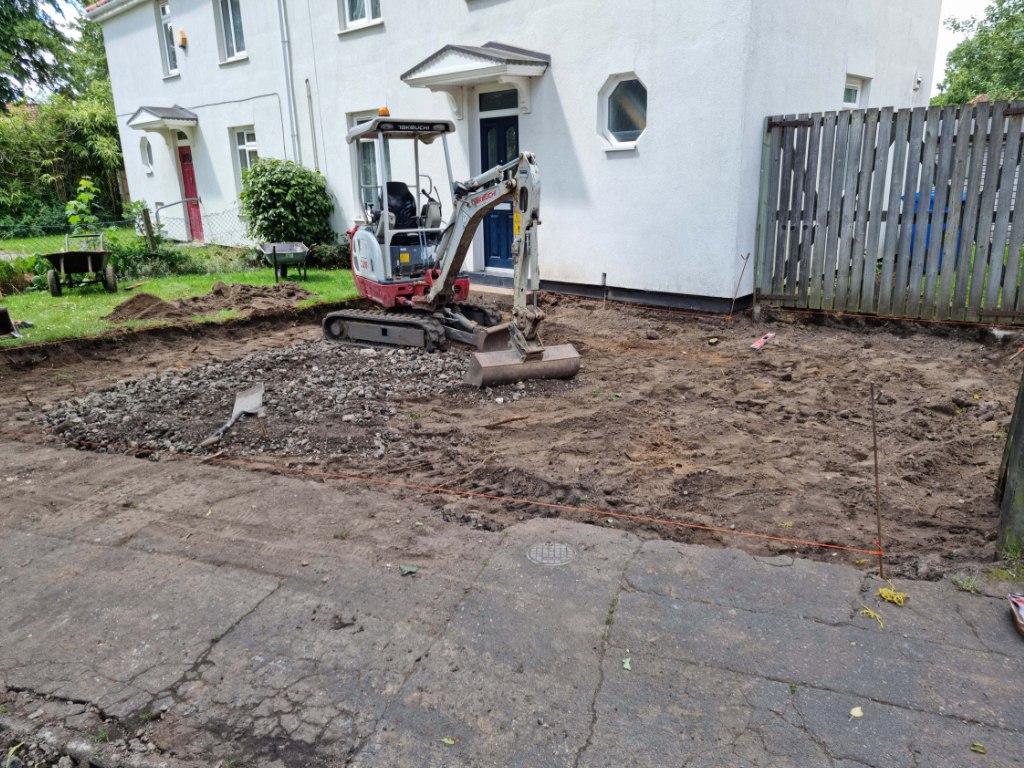
Block paving can adapt to unusual shapes, but its performance still depends on the construction beneath it. A well-prepared foundation distributes vehicle loads and helps prevent settlement.
The installation process may include:
- Excavating to an appropriate depth
- Preparing a stable sub-base
- Compacting each layer thoroughly
- Establishing the required drainage falls
- Installing secure edge restraints
- Adding a consistent laying course
- Compacting and jointing the finished paving
Irregular edges require particular attention because poorly supported cut blocks can loosen or sink.
Working Around Trees and Garden Features
Existing trees, planting areas or decorative features can sometimes be incorporated into the driveway design. However, sufficient space should be retained around features that could affect the paving.
Tree roots and ground movement may disturb the surface if the layout is planned too tightly around them. The design should also avoid leaving very small pieces of paving beside obstacles, as these can be difficult to secure effectively.
A considered layout can preserve useful garden features while maintaining a practical paved area.
Avoiding Too Many Small Cut Blocks
Cutting blocks is often necessary on an irregular driveway, but excessive numbers of narrow pieces can weaken the finish and create an untidy edge.
A skilled installer can adjust the laying pattern, border width or starting position to reduce awkward cuts. Careful setting out before installation begins is therefore essential. Small design changes at this stage can make the completed surface look substantially more refined.
Can Different Areas Be Visually Connected?
An irregular driveway may include parking bays, a turning space and a path leading towards the property. Block paving can visually connect these areas using consistent colours, patterns and borders.
Subtle changes may then be used to distinguish separate functions. For example, a border can mark the edge of a pedestrian route without making it feel disconnected from the main driveway.
Maintenance Benefits of Individual Blocks
One practical advantage of block paving is that individual units can be lifted when access beneath the surface is required or when a localised area needs attention. The blocks can then be reinstated carefully.
Routine maintenance may include removing debris, controlling unwanted growth in the joints and replacing jointing material when necessary. Any movement or sinking should be investigated so that the underlying cause can be corrected.
Conclusion
Block paving is highly suitable for many irregularly shaped driveways. Its modular construction can accommodate curves, angles, changing widths and existing garden features while providing a strong, attractive surface.
Successful results depend on thoughtful design, accurate cutting, secure edges, effective drainage and a properly prepared foundation. If you are considering block paving for an unusual driveway layout, NS Driveways Farnham can assess the space and recommend an appropriate design. Contact our team for professional driveway installation in Farnham, Surrey.
Call us on: 01252 941 699
Click here to find out more about NS Driveways Farnham
Click here to complete our contact form and see how we can help with your driveway needs.