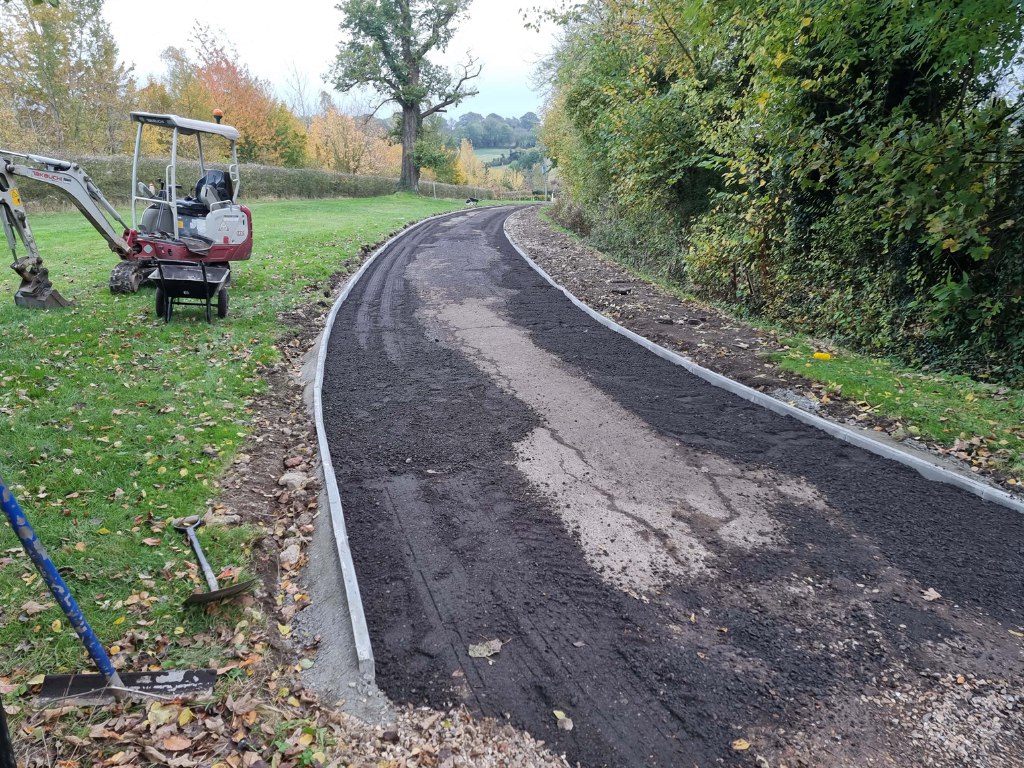
How Do You Know When Driveway Resurfacing Will Be Enough?
An ageing driveway does not always need to be completely replaced. Surfaces can become faded, worn, cracked or uneven over time while the underlying construction remains sufficiently stable. In these circumstances, resurfacing may provide an effective way to restore the driveway without rebuilding it from the ground up.
The key question is whether deterioration is mainly affecting the surface or whether problems extend into the underlying layers. Resurfacing over an unstable base will not correct the cause of movement, settlement or repeated failure.
For property owners in Farnham, Surrey, assessing the complete condition of an existing driveway before deciding on resurfacing is therefore essential. A professional assessment can establish whether the current structure provides a suitable foundation for a renewed surface.
When Is Driveway Resurfacing the Right Solution?
Driveway resurfacing is generally most appropriate when the existing base remains stable but the upper surface has deteriorated.
The existing driveway effectively provides the foundation for the new surface. It therefore needs to be capable of supporting the resurfacing work without significant movement or structural weakness.
This means the decision should not be based purely on appearance. A driveway can look considerably worn while remaining structurally suitable for resurfacing. Conversely, a surface that appears relatively acceptable may conceal movement or deterioration beneath it.
Surface Wear Does Not Always Mean Structural Failure
Driveways experience continual exposure to vehicle movements and changing weather conditions. Over time, this can affect the appearance and condition of the upper surface.
Wear may include fading, minor deterioration or a generally tired appearance. These signs do not necessarily mean that the complete driveway construction has failed.
Where deterioration remains concentrated near the surface and the underlying structure is sound, resurfacing can restore a more consistent finish while retaining the existing foundation.
The important distinction is between superficial deterioration and defects caused by movement below the surface.
A Stable Base Is Essential
The condition of the underlying base is one of the most important considerations when deciding whether resurfacing will be enough.
A new surface cannot compensate for a foundation that is moving, sinking or breaking down. If the base lacks adequate stability, defects may eventually transfer through the resurfaced layer.
Before resurfacing, the driveway should therefore be assessed for signs of underlying movement.
A sound base provides a stable platform on which the renewed surface can perform properly. Where weaknesses are identified, they may need to be addressed before resurfacing is considered.
What Do Cracks Tell You About the Driveway?
Cracking should be assessed carefully because not all cracks indicate the same problem.
Limited surface cracking may sometimes be associated with deterioration of the upper layer. However, extensive cracking, recurring cracks or patterns accompanied by movement can indicate deeper problems.
Simply covering significant cracks without understanding why they developed can allow the same weakness to reappear.
A professional assessment looks at the position, extent and characteristics of cracking rather than treating every crack in exactly the same way.
Localised Damage May Not Require Full Reconstruction
A driveway can sometimes contain one or two damaged sections while remaining stable elsewhere.
In this situation, localised preparation or repair may allow the overall driveway to remain suitable for resurfacing. The damaged sections need to be dealt with correctly so they do not undermine the finished surface.
This is why identifying the extent of deterioration matters.
If problems are genuinely confined to limited areas, it may not be necessary to disturb sections that continue to perform correctly. If similar defects are widespread throughout the driveway, a different approach may be more appropriate.
Uneven Areas Need Proper Investigation
An uneven driveway does not automatically rule out resurfacing, but the reason for the unevenness needs to be understood.
Minor surface variations may be manageable during preparation. Significant dips, depressions or sunken sections can indicate settlement within the underlying construction.
Resurfacing without correcting the cause may improve the appearance temporarily while leaving the original weakness in place.
The objective should therefore be to create a stable and suitably prepared foundation before applying the new surface.
Drainage Should Be Considered Before Resurfacing
Water management is an important part of driveway performance.
If water regularly collects in particular areas, simply resurfacing the driveway without considering why ponding occurs may leave the problem unresolved.
Low spots, unsuitable falls or deterioration that has changed the surface profile can all influence where water travels.
Before resurfacing, the existing driveway should be assessed to determine whether its levels and falls allow water to move appropriately. Where necessary, preparation can take the intended finished profile into account.
Previous Repairs Can Reveal Useful Information
The repair history of a driveway can help indicate what is happening beneath the surface.
One isolated repair does not necessarily suggest a wider problem. However, numerous repairs across different sections can indicate that deterioration is becoming more widespread.
It is particularly important to consider whether previous repairs have remained stable.
If repaired areas repeatedly crack, sink or deteriorate again, there may be an underlying issue that needs attention before resurfacing.
Rather than simply covering previous repairs, understanding why they were necessary provides valuable information when deciding the next step.
The Existing Edges Also Matter
The main driving surface is not the only part of the driveway that should be assessed.
Edges help define and support the finished area. Where they have become damaged, loose or poorly defined, preparation may be required before a new surface is installed.
Changes around entrances, adjoining paths and other transitions also need consideration so that the finished surface connects properly with its surroundings.
These details contribute significantly to how well resurfacing performs and how complete the finished driveway appears.
Preparation Determines the Quality of Resurfacing
Successful driveway resurfacing depends heavily on what happens before the final surface is applied.
The existing area needs to provide a suitable foundation. Loose or unsuitable material should not simply be covered, and damaged areas need appropriate attention.
Depending on the condition of the driveway, preparation may involve correcting localised defects, dealing with unstable sections and ensuring that the surface is ready to receive the new material.
This is why resurfacing should be viewed as a construction process rather than simply applying a fresh layer over an old driveway.
When Resurfacing May Not Be Enough
Resurfacing becomes less suitable when deterioration is caused by widespread problems within the underlying construction.
Warning signs can include:
- extensive settlement across several areas
- widespread movement or deformation
- recurring cracks following previous repairs
- significant depressions or unstable sections
- deterioration affecting large parts of the driveway
- an underlying base that no longer provides consistent support
- substantial problems with the existing surface profile
These signs do not determine the required work individually, but they indicate that a more detailed assessment is worthwhile.
Where the foundation itself is unreliable, rebuilding affected areas may provide a more appropriate basis for the finished driveway than simply resurfacing over them.
Why the Whole Driveway Should Be Assessed
It can be tempting to focus on the most visibly damaged area, but a driveway should be considered as a complete surface.
One section may be cracked while another has started settling. Elsewhere, the surface may appear worn but remain structurally sound.
Looking at these conditions together helps establish whether deterioration is isolated or widespread.
At NS Driveways Farnham, we assess the existing surface and its overall stability before recommending an appropriate approach. The objective is to determine whether resurfacing can provide a dependable result rather than assuming that either resurfacing or full replacement is automatically necessary.
Resurfacing Can Transform a Structurally Sound Driveway
Where the foundation remains suitable, resurfacing can make a substantial difference to both appearance and usability.
A worn surface can make an otherwise functional driveway look tired and poorly defined. Renewing the surface creates a more consistent finish and can address suitable areas of surface deterioration as part of the preparation process.
The crucial point is that the new surface should be supported by a dependable structure beneath it.
When this condition is met, retaining the sound parts of the existing driveway can be a practical approach.
Do Not Base the Decision on Appearance Alone
Visual condition provides useful clues, but it cannot tell the complete story.
A heavily weathered driveway may still have a stable foundation. A driveway with relatively limited visible damage could have areas of underlying movement.
The most useful decision therefore comes from considering several factors together:
- surface condition
- cracking
- levels and settlement
- drainage
- previous repairs
- edge condition
- underlying stability
This creates a much clearer picture of whether resurfacing will be sufficient.
Professional Assessment Helps Avoid Unnecessary Work
The purpose of assessing an existing driveway is not to assume that everything needs replacing.
A professional assessment should identify which parts remain suitable, which areas require preparation and whether the underlying construction is capable of supporting a renewed surface.
For homeowners in Farnham, Surrey, this provides a more informed basis for planning driveway improvements.
Where resurfacing is suitable, it allows sound existing construction to remain in place. Where deeper deterioration is identified, addressing it before the final surface is installed can help produce a more reliable result.
Conclusion
Driveway resurfacing can be an effective solution when deterioration is mainly confined to the surface and the underlying base remains stable. Wear, minor defects and a generally tired appearance do not automatically mean that the complete driveway needs rebuilding.
However, resurfacing cannot correct widespread settlement, significant movement or an unstable foundation. These problems need to be identified before a new surface is installed.
The best way to determine whether resurfacing will be enough is to assess the driveway as a complete structure, considering its surface condition, base stability, drainage, previous repairs and any signs of movement.
If your driveway in Farnham, Surrey is showing signs of wear and you are unsure whether resurfacing is suitable, contact NS Driveways Farnham. We can assess the existing condition and recommend an appropriate approach based on what the driveway actually requires.
Call us on: 01252 941 699
Click here to find out more about NS Driveways Farnham
Click here to complete our contact form and see how we can help with your driveway needs.